Sunday, July 22, 2012

Bergen Part IV: Where Musicians Live

This is the fourth in a four part series on my trip to Bergen, on Norway's west coast. If you'd like to start over at the beginning, you can find the first post here:
http://kristofergoestonorway.blogspot.no/2012/07/bergen-part-1-go-west-young-man.html

On Saturday, our last day on the west coast, we had two stops to make, visiting the homes of Norway's two most famous musicians, both of whom called Bergen home during their lifetimes.
If you remove the Russian Orthodox turret and the
Arabian porch, it's a classic Norwegian home...
Our first stop took us on a short ferry ride to the island home of the violinist Ola Bull. While he is almost forgotten outside of Norway these days, at the height of his popularity, Ola Bull may have been the most famous violinist in the world. He was immensely talented and accumulated fabulous wealth on account of it, which he promptly spent on things like a private island and founding a colony in America (a fact which I alone in our tour group knew, thanks to the honorable Todd Nichol). He was also an expert showman, early in his career paying women to faint at his concerts, whereupon he would venture down into the audience to revive them. Later on in his career, the women would do the fainting without being paid, at some points even lining up outside his hotel to purchase his bath water.
A portrait of the artist as a young man
His career as a violin virtuoso aside, he is notable in Norwegian (and art history) as the discoverer of not only Henrik Ibsen, but Edvard Grieg. In fact, Ola Bull was responsible for Grieg's parents sending him to Leipzig to study.
Don't tell anyone, but seeing this jellyfish may have been
my favorite part of the tour.
Speaking of Edvard Grieg, his house, known as Troldhaugen, was our second stop. Here again we toured the artist's house and learned many things about him. For instance, he was a small man, 5' 2" tall, married his cousin, and had a rubber frog he would carry around and rub before every concert. His eccentricities aside, Edvard Grieg may be the most world famous Norwegian, known especially for the incidental music to Henrik Ibsen's play, Peer Gynt. Even if people don't know Grieg's name, they are sure to recognize the theme from his piece "In the Hall of the Mountain King", which describes a scene where the main character, Peer Gynt, is chased around by the troll children of the Mountain King, whose daughter Peer Gynt has tried to abscond with. We didn't spend much time at Grieg's house (like the man himself, it was quite small), and so afterwards we headed back to our hotel to say our goodbyes to Bergen and prepare for the long bus ride back to Oslo.
Edvard Grieg and I. The statue is life-sized, so you can see,
he was no Nordic giant.

Thursday, July 19, 2012

Bergen Part III: Av Kirker og Kristoferer (Of Churches and Kristofers)

This is the third in a four part series on my trip to Bergen, on Norway's west coast. If you'd like to start over at the beginning, you can find the first post here:
http://kristofergoestonorway.blogspot.no/2012/07/bergen-part-1-go-west-young-man.html

The Altar, Pulpit and Organ in Nykirke (The New Church)
Saturday, after a short walking tour of the city, we had from 11 in the morning until 7 in the evening free, and so I decided to indulge myself a little and visit the churches in the old section of Bergen, down by the water. There are five large, Lutheran churches in the parish of Bergen, within fifteen minutes walking of each other. One of them, Mariakirke (Mary's Church), is closed for renovation until 2015, so that gave me four churches to visit that afternoon. My first stop was Nykirke (the New Church), on the south side of the harbor, two blocks from the water. After I had gone inside and looked around for a little bit, I asked the lady who was showing another couple around the church whether I could take pictures. She said yes, and asked where I was from, and when I said I go to school in Minnesota, she got excited and introduced me to her husband. Her husband was a retired pastor, who grew up in Long Beach, graduated from PLU and Luther Seminary, St. Paul, and served several parishes in southwest Wisconsin (it's a small world isn't it?). I had a pleasant chat with him (although he did make fun of me a little for being from "cream of the crop" St. Olaf), and also with the pastor when he showed up.
Johanneskirke (St. John's Church) towering over the Bergen skyline.
My next stop was Johanneskirke (St. John's Church), a little to the south, referred to in the city as the big, red church. Johanneskirke is the tallest building in Bergen and was probably the most impressive of all the church's I visited, richly decorated and featuring quite a bit of woodwork (the other churches are mainly stone). In addition to the rich beauty, Johanneskirke stands at the top of a steep hill and so getting to the church requires a climb up stairs like a penitent going up to St. Peter's in Rome (or at least that's how I felt going up. Never having been to Rome, I can't say whether it's really actually the same).
The Altar i Johanneskirken
Halfway done with my pilgrimage, I headed northwest towards Korskirke (the Church of the Cross). Korskirke was unusual among the four churches I saw in a couple different ways. First off, it was the only church with any people buried outside of it, a fact made even more unusual by its location in the middle of downtown. Graves aside, Korskirke was the only of the four churches that was more impressive on the outside than the inside. Its richly carved stone exterior is a stark contrast to its drab, pale interior. 
The front door of Korskirke
After bidding Korskirke adieu, I headed up the hill towards my final stop, Den bergenske domkirken (the Bergen Cathedral). Now, Kristofer was and is a relatively common name in Norway (however, now it's generally spelled Kristoffer), and so it seems a rather safe guess that many other Kristofers had set foot in the Bergen Cathedral before I did that grey afternoon. While I'm sure that many of those other Kristofers were swell fellows, only one of them was the reason my visit to the cathedral was especially meaningful for me.
The doors to the sanctuary
As many of you know, I am a quarter Norwegian. Half of my Norwegian lineage, the Sethres, comes from Eidsvoll, north of Oslo (where the constitution was signed), but the other half, the Tvedts, is pure Bergen stock, and the last of them to leave Norway was the Kristofer our story is concerned with. Kristofer Olai Nilsen Tvedt, the son of shopkeeper Nils Kristofersen Tvedt, was born in Bergen the 8th of June, 1884, and (more importantly for this narrative) was baptized in the Bergen Cathedral a month later, on the 6th of July. And after a round about journey, 128 years later, his namesake (me!) walked back through those same doors. I though it was pretty nifty, and it's probably been the highlight of my time here in Norway so far.
The high altar in the cathedral, the back piece carved of stone.

Tuesday, July 17, 2012

Bergen Part II: A Little Bit About a Little City

This is the second in a four part series on my trip to Bergen, on Norway's west coast. If you'd like to start over at the beginning, you can find the first post here:  http://kristofergoestonorway.blogspot.no/2012/07/bergen-part-1-go-west-young-man.html

Late Friday afternoon, after our fjord tour, we finally arrived in Bergen, a city of around 200,000 on the south-west coast of Norway. After checking into our hotel, we had nothing to do until dinner, and so armed with a map, a short history of Bergen, and a hotel guidebook I set out to get to know the city.
My first stop was Bryggen (which means 'the wharf'), right on the old harbor. Bryggen, with its historic wooden houses, was the original seat of the Hanseatic League. Bergen has always been an important port for the Norwegian fish trade; all the dried cod which came down from the northern fishing grounds passed through Bergen on its way to Europe. As a result, the Hanseatic League, a guild of German traders, established itself in the 14th century. They came to control the fishing industry and exerted a considerable influence on the culture of Norway's west coast. Bryggen remained an independent, German speaking area of Bergen until the 16th century, when the Norwegian king forced them to integrate, but the League remained in place until the 18th century, and their mark can be seen all over the city. For example, Hansa Beer, based in Bergen, takes its name from the Hanseatic League, and retains its unique heritage by brewing Norwegian beer made from German ingredients.
Note the Hansa logo, one half the Eagle of the
Free city of Luebeck, other half
the red and white shield of the Hanseatic League.
After leaving the wharf front, I wandered up the cobble stone streets. Bergen is a city built in the foothills of seven mountains, and so the streets are narrow, twisted, and steep.

After exploring for a little bit (and marking down the locations of all the churches), I was getting hungry. I had heard that Bergen was famous for a type of cinnamon roll known as the skillingsboller, and my guide book informed me that a bakery called Baker Brun had been making them since 1893. However, try as I might, I could not track down this Baker Brun, and so I had to go without a roll that first day. (Fear not though, on Saturday I finally tracked the place down and tried a skillingsboller. It was quite good, but I will warn Americans who try a skillingsboller that if you're expecting  it to be as sweet as our American cinnamon roll, you may be a little disappointed).
A skillingsboller, with Norwegian flags in the
background to boot.
Having not found a skillingsboller that afternoon and with dinner approaching, I headed back towards our hotel, passing last through the famous Bergen fisketorget. The fisketorget is an open air fish market down by the waterside, with all sorts of delightful offerings, all of which cost a pretty penny. (I still can't quite figure out why the sea food in Norway is so expensive, but rest assured, it is fresh and it is good). 
As much as I wanted to buy a plate of shellfish, a dinner that I had already paid for awaited, and so I passed on the opportunity. My evening meal consumed, I took a short walk, listened to a steel guitarist play Bob Dylan, and then headed up to bed to go to sleep in a city where another young Kristofer, destined to be a pastor, went to sleep 120 years earlier. If I wasn't so tired, it might have been a thought to keep me awake; luckily though, after adapting to my cot, which slanted heavily to the right, I slept like a log.


Monday, July 16, 2012

Bergen Part I: Go West Young Man!

This is the first in a four part series on my trip to Bergen, on Norway's west coast.

On Wednesday, July 11th, after taking a nap and packing, I walked through the rain and got on a double-decker bus to journey along with 70 other summer school students to the city of Bergen. We left at 2 in the afternoon, and started west, away from Oslo. Six long hours later, the bus stopped and we tumbled out into the rain. Our first destination was the Borgund Stave Church, and if you remember my thoughts on the stave church at Heddal, you might understand that I was trying not to get my hopes up too high.
I must say, that I was pleasantly surprised. Our guide was knowledgeable and cheerful, even standing out in the rain to greet us, but more importantly, they had done a much better job preserving the essence of the church. It was quite dark inside (the church only has one window), and the smell of the fresh pine tar that they had recently spread on the outside filled the whole space. The guide did a good job of keeping things quiet, and it was really quite an experience to stand inside and look up at the dark, high ceilings as the first Christians in Norway did a thousand years ago. Also, a useful bit of information from the builders of the church that I pass along to anyone who can use it: The Norwegians refused to build doors on the north side of churches, because they knew that everything evil (mostly winter) comes from the north, and if a door was built on that side, evil would just come waltzing right on in.
A picture I took during my pre-bed walk in Lærdal
After visiting Borgund, we drove another half an hour and arrived in the small town of Lærdal, nestled at the foot the mountains. We dined at a seafood restaurant catering almost exclusively to Japanese tourists (seriously. The menus were in English and Japanese), and then after walking around and watching a mother duck put her ducklings to bed, I followed suit. I slept well, except for when my roommate, returning to the hotel room at an early hour of the morning, opened our window and disturbed the pair of sea gulls and their two chicks nesting outside our window. The seagulls calmed down after a while, and when I woke up to start my day, I packed my lunch and we continued our march to the sea. At about 10 in the morning, we drove through the tunnel to Flaam, which is carved 24 kilometers (about 15 miles) through a mountain. Despite its impressive length, it is as you might expect, rather boring, being primarily a dark tunnel. On the other side, we reached Flaam and boarded a ferry to see one of the famous fjords of Norway.
While it's not an albatross, I'm guessing it's still not good luck.
Though it was raining as we departed, I found a seat under an awning and settled in as we traveled down Sognefjord, the largest fjord in Norway, stretching from the sea 205 kilometers (127 miles) inland. It was beautiful, but fjords share the characteristic of other landscapes possessing beauty in grandeur, in that their really too darn big to capture adequately in a picture. I gave it a shot, but it's really something you need to see for yourself. I really can't even do them justice with words, so having told you that after touring the fjord, we got on the bus and headed down to Bergen, I will give you the best picture I got and leave it at that.


Wednesday, July 11, 2012

Telemark Part 4: We Will Go Through the Mines


This is the fourth in a four part series on my trip to Telemark this past weekend. These posts will be a little on the long side, since so much has happened, but in an effort to hold everyone's attention, I've split the trip up into four smaller posts. If you would like to start at the beginning, you can find the first post here:
http://kristofergoestonorway.blogspot.no/2012/07/telemark-part-1-boats-and-things.html

Thank goodness for that helmet. I must have hit my head
 on the ceiling at least 5 times down in the mine.
As the last stop on our Telemark trip, we visited Blaafærverket (literally 'the Blue Color Works'), a cobalt mine. Cobalt is a mineral that, when refined, has a brilliant blue color and has been used for many years to make blue glass and to provide the blue in fine china. This was one of three cobalt mines in Norway, but now has been closed and is used primarily as a museum.
In case you were wondering, it is quite dark inside a cobalt mine. In addition, it is quite cold. Due partially to my imprecise math skills, but mostly to my ignorance of the Celsius temperature scale, I didn't realize just how cold five degrees Celsius is and wore shorts on the tour (if you're wondering, five degrees Celsius is just a touch above 40 degrees Fahrenheit). Luckily they provided us with nice warm ponchos and the tour was only an hour long. The tunnels are cut straight into solid rock, and we wandered around them while our guide explained all about how terrible it is to work down in a cobalt mine, with dangers ranging from poisonous gases to cave-ins to dynamite, etc. The mine is also exceptionally wet; the walls are dripping with condensation, and I must confess that down there in the dark, wet tunnels, I was more concerned with accidentally running into Gollum, than any other danger. 

One final note on the mine. Aside from a large children's camp that they run, the biggest industry that the mine now supports is cheese. Evidently the cool, dark tunnels are perfect for the storing and aging of expensive Norwegian cheeses. Who'd a thunk it?
Well, that's all from Telemark for me. I'm off to Bergen today, and so in a little while, I'll have a little bit to report on Vestlandet and the Tvedt's ancestral home.

Tuesday, July 10, 2012

Telemark Part 3: Heddal Stave Church

This is the third in a four part series on my trip to Telemark this past weekend. These posts will be a little on the long side, since so much has happened, but in an effort to hold everyone's attention, I've split the trip up into four smaller posts. If you would like to start at the beginning, you can find the first post here:
http://kristofergoestonorway.blogspot.no/2012/07/telemark-part-1-boats-and-things.html

On Sunday morning, I climbed out of my skinny little bed at Uppigård Natadal and headed down to breakfast, where I nourished myself on hearty home baked bread, soft-boiled eggs, and pickled herring. I had never had a soft-boiled egg before, and I must say I'm a pretty big fan. Anyways, that's beside the point. After breakfasting, we piled onto the bus once again and headed down into another valley to see the Heddal Stave Church.

A little background on stave churches, in general. Stave churches are so-called because they are supported by staves, four large beams placed at the corners of the sanctuary. They are constructed entirely of wood, and were built about 800 years ago, about a hundred years after Christianity first came to Norway. Because of the time period in which they were built, the churches are a fascinating blend of old Viking animal carvings,  Roman Catholic motifs, and (later) Lutheran additions. The inside of the stave churches are very dark. There are no windows, just a small skylight. 
The Altar
As for the Heddal Stave church, it was a mixed bag. First the good: The church is beautiful, and well-preserved enough that it can still be used for weddings and baptisms. Unfortunately, that's about it for the good.
The door of the church, carved with dragons to protect against evil.

Even though it is beautiful, or perhaps because it is beautiful, at this point in time, the church has become little more than a tourist attraction. It's locked most of the time, and can't be entered without a 65 kroner ticket, and the few times it is opened, it's filled with the flash of tourists cameras as they run around taking pictures. After the tourists have gotten their shots, a grumpy Norwegian college student points out several features of the church he's been paid to memorize and then everyone is ushered out. Perhaps it is a telling picture of the religious state of Norway today that the atmosphere of the church has been destroyed; at any rate, they treat what could be an awe-inspiring church space as little more than a curio, no more sacred than the art gallery downtown. I, for one, was quite disappointed to say the least.

Having stood on my soapbox and harangued the multitudes, in an effort to cheer you, my reader, up (and myself), I'll leave you with a prime example of the finest art in Telemark, rosemaling. This picture is of the ceiling of a house dating back to the 1600s, and not only the ceiling, but all four walls were covered with the delicate paintings. I'm not sure how I'd like to live in a room decorated like that all the time, but it was really quite nice to lie on the floor for five minutes or so and stare at the handiwork of some long-ago artist.


Monday, July 9, 2012

Telemark Part 2: A Shortcut for Hazelnuts

This is the second in a four part series on my trip to Telemark this past weekend. These posts will be a little on the long side, since so much has happened, but in an effort to hold everyone's attention, I've split the trip up into four smaller posts. If you would like to start at the beginning, you can find the first post here:
http://kristofergoestonorway.blogspot.no/2012/07/telemark-part-1-boats-and-things.html

After our afternoon at the Vrangfoss Locks, our bus headed away from the Telemark Canal and into Norwegian dale country. Our destination was Uppigård Natadal. Uppigård, meaning "upper farm", refers to the location of the farm on the hillside 1,200 feet above the valley floor, and Natadal, which means Hazelnut Valley, refers to the valley the farm is located in. When we arrived at the farm, the persistent drizzle had not let up, and so we stood around in the rain looking at the farm buildings.
A traditional sod-roofed farm house, with a Norwegian farmer coming out of it.

Uppigård Natadal is still a working farm, with a few sheep and chickens, but the owners have turned it into an historic bed and breakfast. Most of the farm buildings were built in the 1700s and some even date back to the 1400s, before the Great Plague. The interiors, of course, have been renovated and installed with all sorts of modern conveniences, like running water and electricity. The couple who own the farm still live on the premises, but the nuts and bolts of the bed and breakfast are managed by a hired lady.
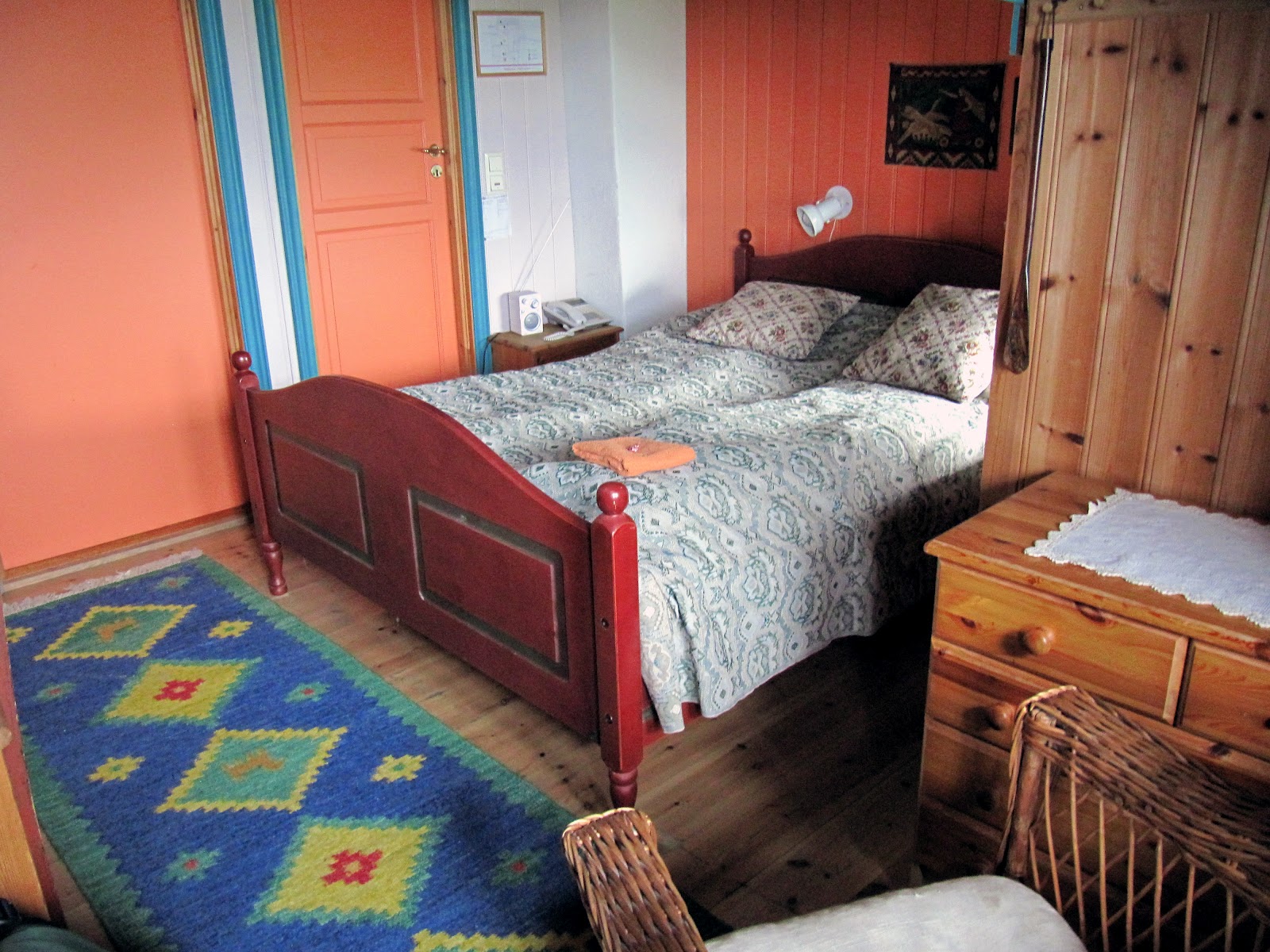
My first room.
After we stood around for a bit, the manager ushered us inside and started handing out room keys. (A short comment which will become relevant shortly: The manager did not speak any English, and so because I have advanced to the point where I can hold a conversation in Norwegian (!), and despite her rather strong Telemark accent, I was one of the few people in our group who could communicate with her). They had passed a sign up sheet for rooms on the bus and though I was last to sign up, I had gotten a double room all to myself. I was feeling pretty lucky, but I guess the Norwegian Lutheran in me should have known that good luck like that doesn't last very long.
Just after I had put my stuff down and stepped outside for a breath of fresh air, the manager hailed me in Norwegian from the balcony and asked if I would be nice enough to switch rooms with one of the girls from our group. There wasn't really any reason for me to say no, so I agreed, whereupon the manager informed me that the girl needed to switch because she was claustrophobic. This puzzled me for all of the two minutes until I found the room that the girl had vacated. I'm lucky that I'm a thin guy, because the room was about three feet wide. It wasn't really bad, and I can understand why it made the girl claustrophobic. I didn't spend very much time in there other than at night, and it didn't affect my sleeping at all, so I guess I have nothing to complain about.
Well, that's not quite true. Unfortunately, despite its person sized bed, the room must have been designed as guest lodgings for elves, gnomes, and/or trolls, because the door was all of four feet high. I probably hit my head on it at least five times during my stay. So, aside from a slight headache and the manager referring to me as Gutten med det lille roomet, "the boy with the little room", my minute lodgings were quite fine.

We had arrived about four in the afternoon, and dinner was not to be served until eight, and so the owner of the farm gave us a guided tour, and then settled us down to relate some Norwegian farmer wisdom. I wrote down some of the choice bits of advice and will pass them along here.
1. To keep ghostly hordes, spooks, and other creatures in league with the devil from entering your house, eating your flat bread and drinking your beer, draw crosses on the lintels with tar.
2. Never forget to move the nisse. The nisse, as you may or may not know, is a little fellow who looks a bit like a skinny garden gnome and lives in the barn. If he's happy he protects the animals, but if he's not, he lets them out and causes all sorts of havoc. And an easy way to make him unhappy is to build a new barn and forget to invite him in. Porridge is generally the best form of invitation.
3. Always hang a cross over the crib of an unbaptized baby. Otherwise a mountain troll will sneak into the house and steal your baby, leaving one of its mountain troll children in its place.
4. On Christmas eve, the ghosts of dead farmers who didn't receive a Christian burial will come back to try and claim their beds. To prevent this, go outside at 5 pm on Christmas Eve and shoot a gun off three times (once each for the Father, Son, and Holy Ghost).
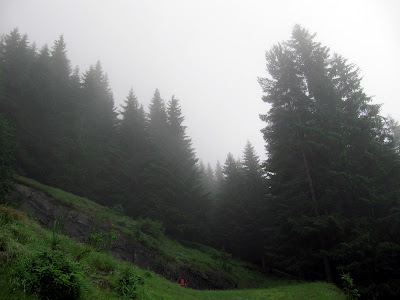
That forest looks like a prime spot to find a troll, a spook, or a ghostly horde .
After receiving farm wisdom, I walked around outside a bit, taught some people from Vietnam and Poland how to play Go-Fish, and did a little reading. Having seen the farm, I must say that farming in Norway could only have been hard. The farm is surrounded by a dense pine forest, and the ground available to plant on slopes downhill at an angle of almost 50 degrees. The Norwegians must have rejoiced when they came to Minnesota and found flat land to plant on. And if the flatness of Minnesota made them happy, just think of their reaction when they got to North Dakota.
Anyways, farming aside, the last main event at Uppigård Natadal was dinner, prepared in authentic Telemark fashion by the Danish chef. We were served an appetizer salad garnished with smoked sei, a relative of the cod (which I think we call a pollack in the United States), along with fresh baked flat bread and Telemark butter, which is butter made with sour cream instead of sweet cream. It's really quite good.
The main course was roast lamb with carrots and potatoes grown on the farm, and dessert was a caramel flan garnished with hazelnuts from the valley.
Den fineste norske akevitt!
To make sure the meal was authentically Norwegian, our hosts offered us aquavit (akevitt in Norwegian) to be drunk as snaps with our appetizer of smoked fish. Aquavit  is the official Norwegian liquor, and is made from potatoes, seasoned with caraway seeds, and aged in oak barrels. It is also extraordinarily strong, and the caraway seeds give it almost a spicy flavor. I think it's an acquired taste, and I'm not sure I can recommend it, but the Norwegians sure are proud of it, and it's supposed to help digest fatty meals like Christmas dinner. 

Dinner took two hours, and then sleepy from all the food, I headed outside for a last breath of mountain air and a look down into the valley which by that point was obscured totally by fog. Then, I crouched down into my little room, curled up (well, stretched straight out, the walls were too close together to curl up), and slept soundly until the morning.